Most women would be happier if they stopped fighting for independence and learned to submit.
I know how that sounds. I know the fury that statement will generate. The accusations of internalized misogyny. The insistence that I'm setting women back decades. The certainty that I must be damaged, brainwashed, or lying.
Good.
Because that fury—that immediate, visceral rejection of even considering submission as a valid choice—is exactly what kept me miserable for years.
The Woman I Was
At 22, living in a converted trailer behind my parents' house, working 42 hours a week to pay off the credit card debt from my flight home from Asia, I would have been just as furious at the woman I've become.
I would have told her she was oppressed. That she didn't know her own worth. That she needed to fight for her independence, her autonomy, her freedom.
I would have been wrong.
A decade later, having built a successful life through conscious submission to a man, I understand something that version of me couldn't: independence isn't the path to happiness for everyone. For some of us, it's the obstacle.
What Independence Actually Delivered
From the moment I could understand language, the message was clear: independence equals happiness. Get your own money. Make your own choices. Need no one. The modern woman's holy trinity.
So I pursued it with religious fervor.
Age 17: Left home for Katimavik, nine months of government-funded "freedom" that was supposed to transform me. It didn't.
Age 18-21: Tried college three times. Agricultural technology, then sciences, then humanities. Each program promised autonomy through education. Each one ended in defeat.
Age 22: Ran to Asia. Vietnam. Cambodia. Thailand. Backpacking until my savings ran out, convinced that if I could just get far enough from home, I'd find the freedom that would finally make me happy.
Every attempt followed the same script: More independence = More happiness.
The script was wrong.
"You'll have so much freedom," my mother said about getting my driver's license. She meant freedom for her—freedom from driving my siblings. But I heard it as my ticket to independence.
I failed that test three times.
Looking back, I realize independence—at least the kind everyone kept selling me—was an illusion. A promise that never delivered. A framework that made everything harder while insisting it was making me free.
The Exhaustion Nobody Mentions
Here's what no one tells you about independence: it's fucking exhausting.
Every decision becomes a test of your autonomy. Every choice carries the weight of proving you don't need anyone. You can't ask for help without admitting failure. You can't lean on someone without questioning your strength. You can't surrender to a moment without wondering if you're betraying your potential.
At 22, I'd been independent for years. I'd worked since I was legal to work. I'd traveled to countries where I knew no one. I'd made every decision myself, answered to no one, needed nothing from anyone.
And I was profoundly, bone-deep miserable.
Not the dramatic misery of crisis—the quiet, grinding misery of someone running on empty but unable to stop because stopping would mean admitting that maybe, just maybe, the entire framework was broken.
Between shifts at the restaurant where I served other people's celebrations, I wrote. Short stories about women discovering power through surrender, finding freedom in restraint. I posted them anonymously online, told no one, and kept exploring these ideas in secret while living in conditions I'm not proud of.
Even then, I knew something the independent version of me refused to admit: the contradictions made sense. Surrender and power weren't opposites. Restraint and freedom weren't enemies.
Independence had given me: unfinished degrees, credit card debt, no direction, no peace, and a growing suspicion that I was doing everything wrong despite following all the right advice.
What it hadn't given me: happiness.
The Choice That Changed Everything
Then I met him.
Through unconventional means I won't detail here. A man twenty years older than me, successful, confident, living with the kind of autonomy I'd been chasing but never catching.
He didn't promise to fix me. He didn't offer to save me. What he offered was something I'd never experienced: clarity.
"I'm not looking for a girlfriend," he told me early on. "I'm looking for a partner to build with."
The difference mattered. A girlfriend is an addition to an existing life. A partner is someone you create a new life with. And what he was building required something specific: complete trust. Complete surrender. Complete submission.
Not blind obedience—we barely knew each other. But the willingness to let him lead while I learned. To trust his direction while I found mine. To submit not out of weakness, but out of strategic choice.
For the first time in my life, someone was asking me to stop fighting for control I'd never really had anyway.
The question wasn't "Can I survive alone?" I'd proven that thoroughly. I could work alone, travel alone, decide alone, suffer alone.
The question was: "What if everything I've been told about independence is wrong?"
What Submission Actually Gave Me
A decade later, the answer is undeniable.
Submission didn't take my autonomy—it revealed that the kind of autonomy I'd been chasing was a trap. The belief that needing no one makes you free. That accepting guidance means surrendering your power. That choosing to follow is weaker than insisting on leading.
Here's what conscious submission to the right person actually delivered:
Focus I'd never had. When someone else holds the compass, you can stop spinning and start moving. Every decision I'd made before required endless deliberation, second-guessing, anxiety about every possible outcome. Under his guidance, I could channel that energy into execution instead of endless deliberation.
Growth I'd been avoiding. Independence told me I should already know what I'm doing. Submission freed me to admit I didn't, to learn without shame, to become someone new instead of proving I was already complete.
Peace I'd never felt. The exhausting fight for control—over my circumstances, my future, other people's perceptions—could finally end. Not because I gave up, but because I chose to fight different battles.
Purpose I'd been searching for. All that frantic searching—across countries, through programs, between jobs—was really just searching for direction. He didn't give me purpose, but his clarity helped me find mine.
Actual freedom. The paradox no one warns you about: conscious submission gave me more control, not less. When you choose your structure and who holds the key, it becomes more freedom than most people ever find.
Happiness. Real, bone-deep, daily happiness. Not the fleeting kind from accomplishments or pleasant surprises. The profound contentment of someone who stopped searching because she found her answer.
What I'm Actually Saying
Now let me be clear about what that opening statement actually means.
I'm not saying every woman should submit to any man. I'm not saying submission is inherently superior to independence. I'm not saying women who choose autonomy are wrong.
I'm saying the narrative we're sold—that independence always leads to happiness, that needing someone means you're weak, that submission equals oppression—is too simple to be true.
Some women thrive in independence. They find their power, their purpose, their peace in autonomy. That's real. That's valid. I genuinely celebrate that.
But most women I've encountered who are loudly championing independence? They're as miserable as I was. Exhausted from proving they don't need anyone. Anxious about every decision. Lonely in their self-sufficiency. Angry at anyone who suggests there might be another way.
They're not happy. They're committed to a framework that isn't serving them, but they can't admit it because admitting it feels like betrayal.
That's what I mean when I say most women would be happier if they learned to submit.
Not that they should submit to anyone who asks. Not that submission is easy or simple or right for everyone.
But that many women would benefit from questioning whether the independence they're fighting so hard to maintain is actually making them happy—or just making them exhausted.
The Real Controversy
The reason this conversation is so difficult isn't because submission is inherently controversial.
It's because we've built an entire ideology around the assumption that female independence is always good, always empowering, always the right choice.
Any woman who suggests otherwise—who says "Actually, I tried that and it made me miserable"—gets dismissed as damaged, oppressed, setting women back.
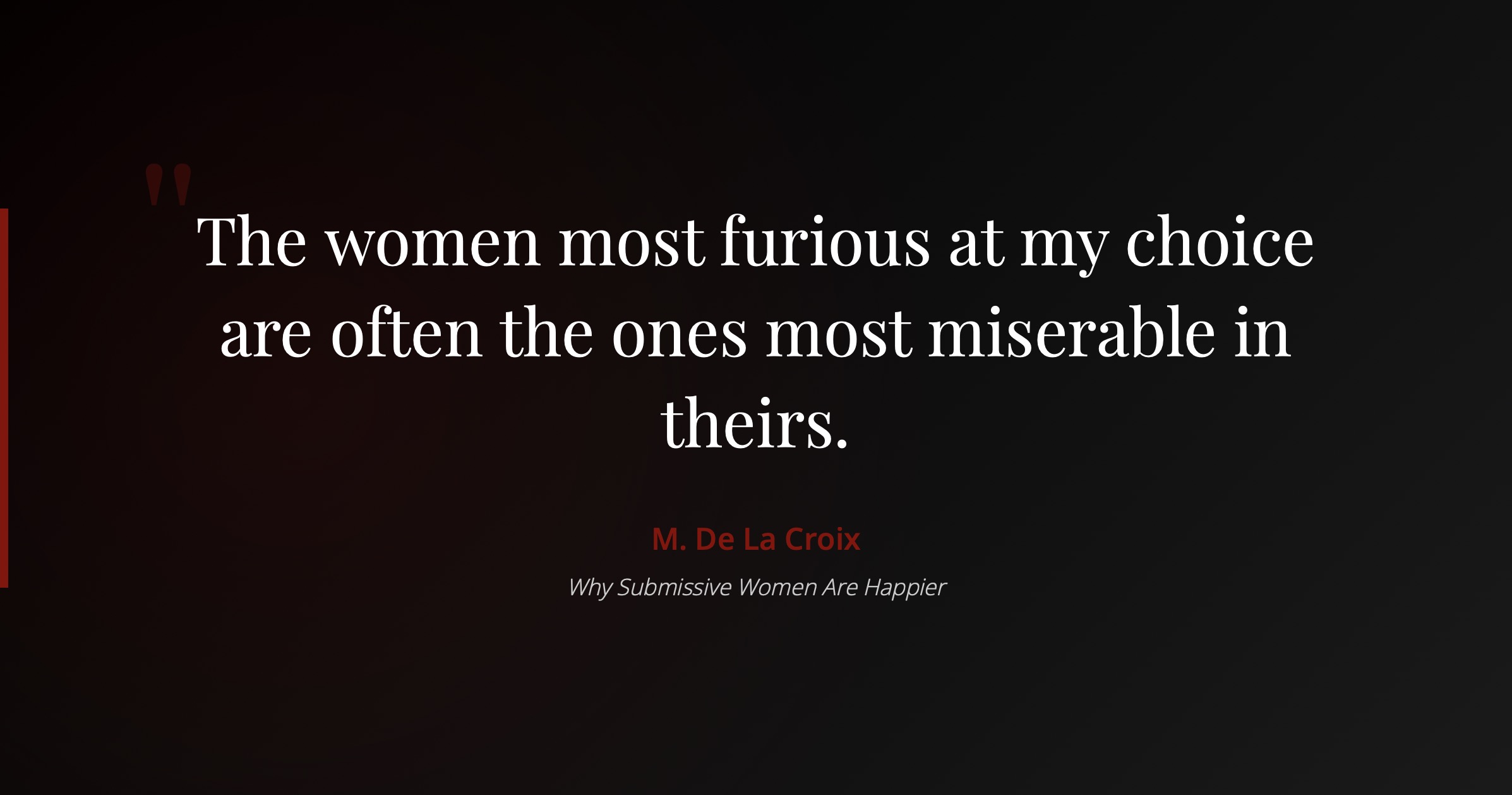
But here's what I learned: the women who are most furious at my choice are often the ones who are most miserable in theirs.
The happily independent women? They don't care what I do. They're busy living their fulfilled lives.
The ones who need to convince me I'm wrong? They're trying to convince themselves they're right.
I tried independence first. I gave it every chance. I followed all the rules, pursued all the promises, did everything I was told would lead to happiness.
It gave me nothing but exhaustion.
Submission gave me everything independence promised but never delivered.
A decade later, I've never been happier.
And I'm willing to bet that pisses off exactly the women who need to hear it most.
The Question
So here's what I'm actually asking:
Are you independent because it makes you happy? Or are you independent because you've been told it's the only acceptable choice?
Are you rejecting submission because it's wrong for you? Or because you're afraid of what it would mean to admit it might be right?
Are you defending your autonomy because it serves you? Or because questioning it feels like surrender?
I chose submission over independence.
Not because I was weak. Not because I didn't know better. Not because I'm damaged or oppressed or setting women back.
But because it made me happier.
And if that statement makes you furious—maybe ask yourself why.
Comments
For the women who are genuinely happy in their independence: I celebrate you. Keep doing what works.
For the women who are exhausted and miserable but can't admit it: I see you. I was you. There's another way.
For everyone else: What if we let women choose for themselves—even when their choice challenges everything we've been told?
Thought-provoking? Share it:
"The women most furious at my choice are often the ones most miserable in theirs."
Follow the conversation:
Read the Full Story
This post only scratches the surface. My memoir, Why Submissive Women Are Happier, explores this transformation in depth—the philosophical questions, the psychological shifts, the cultural assumptions I had to challenge.